

What Is Fascism?
Over the past few years, people have thrown around the term “fascism” pretty loosely. It has been used to criticize any number of issues—proposed environmental regulations aimed at curbing greenhouse gas emissions, stay-at-home orders during a global pandemic, and even legislation limiting the size of sodas. Interesting and funny!
A fascist is a follower of fascism, an extreme political ideology characterized by dictatorial power, extreme nationalism, suppression of opposition, and strong regimentation of society and the economy, exalting the nation or race above the individual. It’s a far-right, authoritarian system emphasizing a centralized government led by a dictator, militarism, and the forcible suppression of dissent, as seen historically in Mussolini’s Italy and Hitler’s Germany, with core beliefs in national rebirth and unity. Core characteristics of fascism: a] Authoritarianism: A powerful central glovernment led by a single dictator, tolerating no opposition. b]Extreme Nationalism: An intense focus on national unity, strength, and often ethnic purity, viewing the nation as supreme. c] Militarism: Glorification of the military, war, and national power. d]Suppression of Dissent: Forcible removal of opposing political parties, ideas, and criticism. d ]Economic Control: Strong government control and regimentation of the economy, often aligning with big business. e]Anti-Democratic: Opposed to liberalism, democracy, socialism, and pluralism.
The word “Facism” comes from the Italian word, fascio, meaning “bundle” or “group,” referring to ancient Roman symbols of authority.It became prominent with Benito Mussolini’s political movement in Italy in the 1920s. While referring to specific historical regimes, the term is often used today as a criticism for authoritarian or ultranationalist movements, particularly those on the far-right that oppose democracy.
Facists, claim to support the everyman, in reality, their regimes often align with powerful business interests, as we saw in the foregoing.
Fascist ideology is typically defined by national rejuvenation.Grievance and Scapegoating: Capitalizing on economic or social unrest by blaming “outsiders” (such as ethnic minorities, immigrants, or political leftists) for the nation’s problems. The term is also commonly used as a pejorative to describe someone who is dictatorial, intolerant of opposing views, or behaves like a bully. Core Principles of Fascist ideology is typically The belief that military strength is the primary indicator of national vitality and that war can be a means of national rejuvenation.Grievance and Scapegoating: Capitalizing on economic or social unrest by blaming “outsiders” (such as ethnic minorities, immigrants, or political leftists) for the nation’s problems.
Benito Mussolini: Founded the National Fascist Party in Italy in 1919 and became the first fascist dictator in 1922. Adolf Hitler: Modeled his Nazi Party in Germany after Mussolini’s movement, implementing an even more extreme form of fascist rule characterized by racial purity and genocide. Francisco Franco under the directives of Victor Emmanuel III handed power to Mussolini, who Led a fascist-aligned military dictatorship in Spain after the Spanish Wars
Facism was used to describe “neo-fascist” movements that retain ultranationalist and anti-immigrant views.
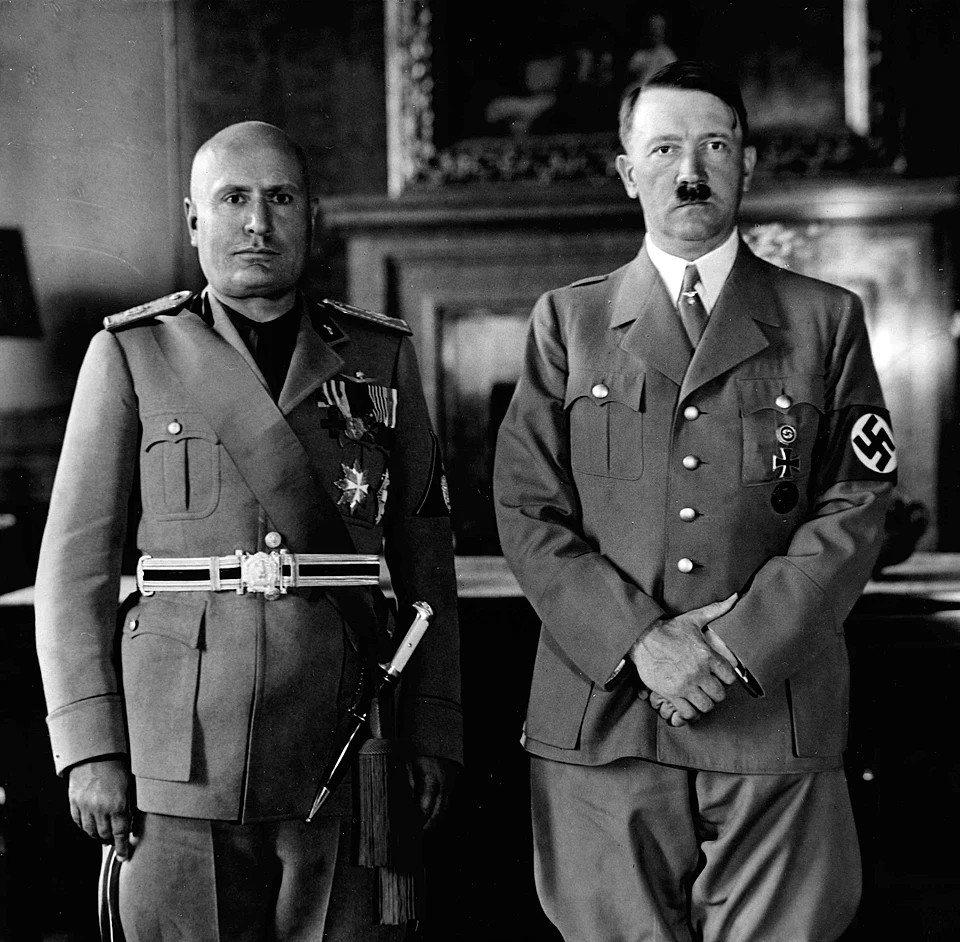
Benito Mussolini Italian Dictator [ Left], and Adolf Hitler, German Dictator [ Right].
Nazi Germany, known officially as the German Reich, and later the Greater German Reich, was the German state between 1933 and 1945, when Adolf Hitler and the Nazi Party controlled the country, transforming it into a totalitarian dictatorship. The Third Reich, meaning “Third Realm” or “Third Empire”, referred to the Nazi claim that Nazi Germany was the successor to the Holy Roman Empire (800–1806) and the German Empire (1871–1918). The Third Reich, which the Nazis referred to as the Thousand-Year Reich, which ended in May 1945, after 12 years, when the Allies defeated Germany and entered the capital, Berlin, ending World War II in Europe.
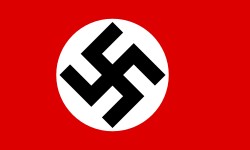
The flag under Adolf Hitler 1935 – 1945, called the Swastika. A flag of pain penury and destruction under fascist Hitler,who tried to purify human race and caused the death of over 5 million Jews!
Victor Emmanuel III appointed Benito Mussolini as prime minister,and chose to remain silent on the domestic political abuses of Fascist Italy, and accepted the History of the Kingdom of Italy (1861–1946) in exchange for Italian neutrality. Victory in the war gave Italy a permanent seat in the Council of the League of Nations. In 1922, Benito Mussolini.Benito Mussolini,1883 – 28 April 1945), an Italian politician and journalist became the dictator of Italy during the Fascist Italian fascism which Benito Mussolini developed in Italy. The ideology of Italian fascism, associated with a series of political parties led by Mussolini. The inevitable fall of his regime in Italy after almost 21 years of Fascist rule in the Kingdom of Italy, came and Mussolini was placed under arrest,marking his end! As prime minister, he transformed the country into a violent military totalitarian Government . The Social Republic Brescia, where Mussolini and the Miistry of Foreign Affairs were headquartered,was thrown down completely in April 1945.
And So, What is fascism? And what does it mean in 2020 America? According to CBS News writer Leslie Gornstein, in April 2020, Tesla founder Elon Musk was angry. The target of his ire was the social distancing measures imposed by California state officials amid the coronavirus pandemic. Mr. Musk was quoted as having said “If somebody wants to stay in their house, that’s great, …But to say that they cannot leave their house and they will be arrested if they do, this is fascist.” But is it? Of Course Not! Before 2016, the word “fascism” popped up mostly in history lessons or political analysis of autocratic states or the occasional terror group. But President Donald Trump’s years in office have seen a surge in “fascism” talk from both supporters and opponents using the word to describe their political adversaries. Can all of them be right? Again, Of course not.
It is a misuse and abuse of word to compare America in any form or manner, with any political Party in America with Facism. President Trump unlike any known facist, has spent most of his tenure so far, stopping wars, brokering peace all over the globe.
During his time in office, Donald Trump’s administration has been involved in brokering several ceasefires and agreements in various long-standing international conflicts and disputes.
His administration has settled settled Wars de-escalated Conflicts that could have blown up to full Wars. In some cases like every thing involving nations in distressed situations, some ceasefires, partial agreements, ongoing conflicts or deep tensions have often continued.
The countries where the President Trump’s administration has mediated or played active roles in reaching peace agreements or de-escalations include: 1) Armenia and Azerbaijan: In August 2025, leaders of both countries signed a declaration at the White House aimed at ending their decades-long conflict over the Nagorno-Karabakh region and normalizing economic relations. A strategic transit corridor was named after Trump in the agreement. 2) Democratic Republic of the Congo (DRC) and Rwanda: A U.S.-brokered peace agreement was signed in June 2025 to end their long-running conflict. However, both sides have since accused each other of violating the terms, and fighting in the region has continued. 3) Israel and Iran: The U.S. brokered a ceasefire in June 2025 after a brief period of direct military engagement, including U.S. involvement in bombing Iranian nuclear sites. The ceasefire has largely held, but core issues remain unresolved,principally due to Iran’s ungodly hateful nature. 4) India and Pakistan: After a military escalation in May 2025, the U.S. mediated a temporary ceasefire between the nuclear-armed neighbors. While a ceasefire was achieved, India disputed the extent of the U.S. role, saying talks occurred through existing military channels.Trump gave them Peace. 5) Cambodia and Thailand: Following a brief border conflict in July 2025, a ceasefire was reached after President Trump threatened to stall separate trade negotiations. Violence later resurged despite the initial agreement. 6)Serbia and Kosovo: In September 2020, under the first Trump term, leaders signed an agreement to normalize economic relations. While a full war did not break out, tense relations between the two persist, and no comprehensive peace treaty has been signed. 7) Egypt and Ethiopia: America was involved in mediating a dispute over the Grand Ethiopian Renaissance Dam on the Nile River during Trump’s first term. However, talks ultimately broke down, no deal was reached, and the core dispute remains unresolved. 8)Israel and Hamas: The Trump administration was involved in a ceasefire agreement following a two-year war in Gaza, which included a plan for hostage releases and a path toward potential long-term peace. The implementation of the plan has been contentious, and a lasting resolution has not been fully achieved. It is important to note that many of these actions resulted in temporary ceasefires. No fascist will broker any peace between nations. They are mostly war mongers President Trump seems to have worked more for peace around the world than most American Presidents of the last two decades. Jealousy or deliberate deception or both working together have blinded and driven many politicians and their supporters to put National Pride behind progress, to cast dark shadows over the towering achievements of Mr. President Donald J Trump. Iam proud of my President any day, any where and at any time and Circumstances. While America may Love the World, it is extremely important to be feared both as a Nation and a President.
Bishop Clement Udegbe writes from Florida USA.