

An Integrative Approach to Schistosomiasis By Livy-Elcon Emereonye
Of all the Neglected Tropical Diseases (NTDs), schistosomiasis stands out as the only one linked to cases where “men menstruate”! But do “men menstruate”?
Schistosomiasis, also called bilharzia, is a parasitic disease caused by blood flukes of the genus Schistosoma. It remains an important public-health problem, particularly in tropical and subtropical regions where people may have frequent contact with freshwater contaminated by the parasite. The disease can affect the urinary tract, intestines, liver and other organs. In children, repeated infection can contribute to anaemia, poor nutritional status, impaired growth and reduced school performance. Long-standing infection can cause serious complications, including liver disease, urinary tract damage and, in uncommon cases, involvement of the nervous system.
An effective approach to schistosomiasis therefore needs to go beyond simply treating the parasite. An integrative approach combines proven antiparasitic treatment with appropriate nutrition, management of complications, safe and carefully selected complementary measures, health education and prevention of reinfection. The most important principle is simple: complementary medicine should complement—not replace—effective treatment where available and affordable.
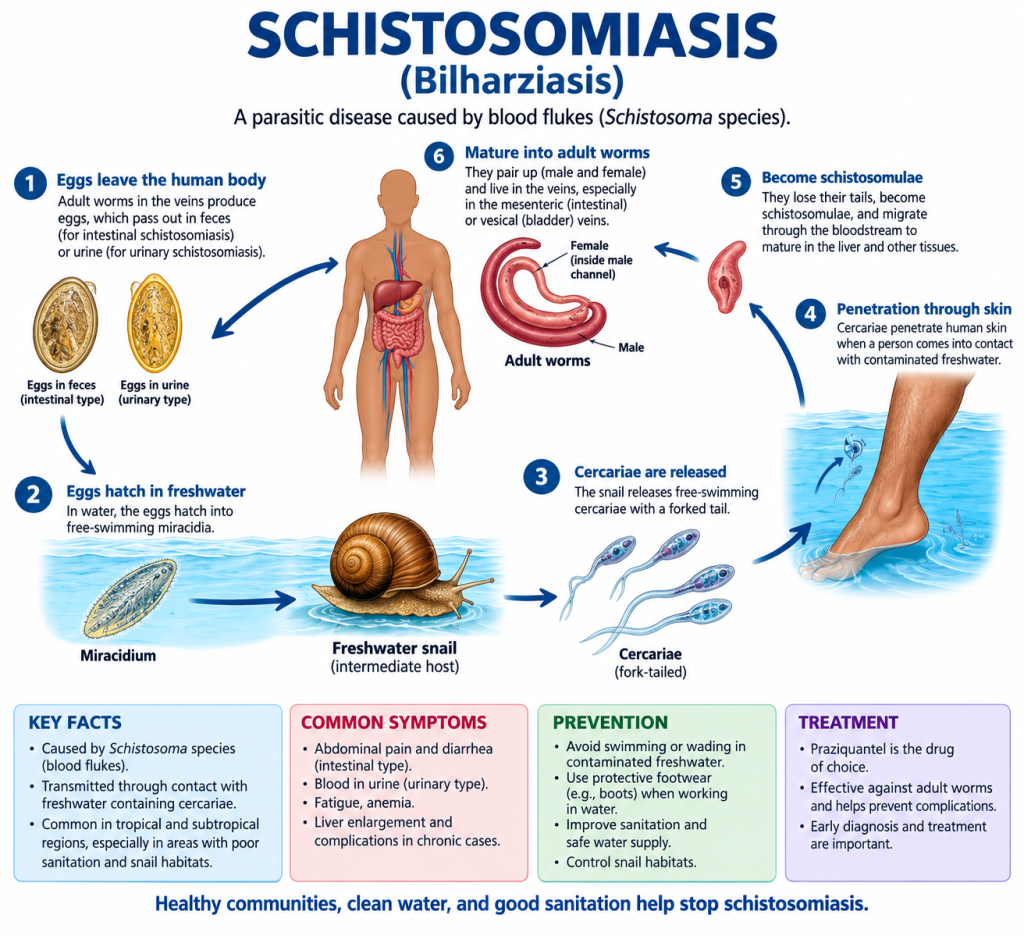
Understanding how schistosomiasis occurs. In a simple term, people become infected when they come into contact with freshwater containing microscopic forms of Schistosoma parasites. The parasites require particular freshwater snails as intermediate hosts.
An infected person can contaminate freshwater when urine or faeces containing parasite eggs enter the water. The eggs develop through part of the parasite’s life cycle in freshwater snails. Infective forms are then released into the water and can penetrate human skin when a person swims, washes, fishes, farms or wades in contaminated water.
Common human-infecting species include Schistosoma haematobium, which is strongly associated with urinary disease, and S. mansoni and S. japonicum, which commonly cause intestinal and hepatosplenic disease.
This life cycle explains why treatment of an individual is only one part of control. A person who has been successfully treated can become infected again if they continue to have unsafe exposure to contaminated freshwater.
Signs and symptoms. The symptoms vary according to the species, intensity and duration of infection. Some people have few or no symptoms initially. Others may develop:
- Itching or a rash shortly after freshwater exposure
- Fever
- Headache
- Fatigue
- Abdominal pain
- Diarrhoea
- Blood in the stool
- Blood in the urine
- Painful urination
- Frequent urination
- Weakness or anaemia
Chronic infection can be much more serious. Urinary schistosomiasis can damage the bladder and urinary tract and may affect the kidneys. Intestinal and hepatosplenic disease can result in enlargement of the liver and spleen, fibrosis around the liver’s portal veins and portal hypertension. Persistent blood in the urine should never simply be assumed to be “worms”. It requires proper medical assessment because other diseases can cause haematuria. Diagnosis comes first . An integrative approach begins with a correct diagnosis. Depending on the suspected species and available facilities, healthcare professionals may examine stool or urine for parasite eggs. Urine testing is particularly useful in urinary schistosomiasis, while stool examination is commonly used for intestinal species.
Other diagnostic methods, including antigen or antibody tests, may be useful in particular circumstances. Blood tests can help assess anaemia and other consequences of chronic disease. Ultrasound and other imaging techniques may be necessary when complications involving the urinary tract, liver or spleen are suspected.
Diagnosis is particularly important before beginning a prolonged herbal programme. A person with chronic schistosomiasis should not spend months treating presumed “worms” with herbs without establishing what is actually causing the symptoms.
Praziquantel remains the cornerstone of treatment
The principal medicine used for human schistosomiasis is praziquantel.
The World Health Organization recommends praziquantel for treatment and large-scale preventive chemotherapy programmes in endemic areas. The appropriate dose is determined according to the infecting species, age/weight and clinical circumstances.
Praziquantel is generally highly effective against susceptible adult schistosomes. However, treatment does not provide permanent immunity. Reinfection remains possible after successful treatment.
Some patients, particularly those with substantial infection or continuing egg excretion, may require follow-up assessment and sometimes additional treatment.
The important message is that no commonly available medicinal herb has been established as a replacement for praziquantel in routine human treatment.
Nutrition as part of integrative care. Chronic schistosomiasis can contribute to anaemia, reduced appetite, poor nutritional status and impaired growth, especially among children living in endemic areas. Good nutrition therefore forms an important supportive component of care. A balanced diet should provide adequate:
Protein: beans, lentils, eggs, fish, poultry, lean meat, soy and other protein-rich foods. Iron: beans, dark-green leafy vegetables, meat, fish and appropriately fortified foods. Vitamin-C-rich foods such as oranges, guava, tomatoes and peppers can improve absorption of plant-based iron. Fruits and vegetables: these provide vitamins, minerals, fibre and other beneficial plant compounds. Adequate fluids: safe drinking water is important, particularly when there is fever, diarrhoea or poor fluid intake. Where anaemia is significant, however, diet alone may not be sufficient. A healthcare professional should determine whether iron or other treatment is required.
Herbal medicine: where does it fit?
Herbal medicine deserves attention because medicinal plants have a long history of use in African, Asian and other traditional medical systems. Researchers have also investigated numerous plants for potential antischistosomal activity.
However, this subject requires scientific honesty. There is a substantial difference between:
- a plant traditionally used for treating worms;
- an extract that kills schistosomes in a laboratory dish;
- an extract that shows activity in an infected animal; and
- a standardized herbal medicine proven to cure schistosomiasis safely in well-designed human clinical trials. The first three do not automatically establish the fourth. Nevertheless, several medicinal plants have attracted scientific interest. Garlic (Allium sativum) Garlic is one of the most widely used medicinal plants in the world. Laboratory and experimental studies have investigated garlic and its constituents for activity against schistosomes. Compounds produced when garlic is processed, including sulphur-containing compounds, have demonstrated biological activity in experimental systems. Garlic also has antimicrobial and antioxidant properties. However, evidence of activity in laboratory or animal studies should not be interpreted as proof that eating garlic or taking a garlic preparation will eliminate established human schistosomiasis. Garlic may be included as a nutritious food, but it should not replace praziquantel.
People taking anticoagulant medicines or preparing for surgery should also discuss concentrated garlic supplements with their healthcare professional because high-dose preparations may affect bleeding risk. Artemisia species Plants of the Artemisia genus have attracted considerable attention in parasitology. Artemisia annua, for example, contains artemisinin, a compound best known for its importance in malaria treatment. Experimental researchers have investigated artemisinin and related compounds against schistosomes, with encouraging findings in laboratory and animal models.
This is an interesting area of research, but it does not mean that Artemisia annua is an established clinical treatment for schistosomiasis.
Self-treatment with concentrated extracts is particularly inappropriate because herbal preparations can vary considerably in concentration and quality. Turmeric (Curcuma longa) Turmeric contains curcuminoids, particularly curcumin, which have been investigated for anti-inflammatory, antioxidant and antiparasitic properties. Experimental research has examined curcumin and turmeric-derived compounds in relation to schistosomiasis. The potential mechanisms include effects on parasite biology and modulation of inflammatory responses. Again, most of the evidence remains preclinical. Turmeric can be part of a healthy diet, but it should not be presented as a proven cure for schistosomiasis. Concentrated curcumin supplements may also interact with medicines and may not be appropriate for everyone. Nigella sativa (black seed) Nigella sativa, commonly called black seed or black cumin, has a long history of traditional medicinal use. Its major constituent, thymoquinone, has been studied for antioxidant, anti-inflammatory and antiparasitic effects. Experimental studies have investigated N. sativa and its constituents in schistosomiasis models. These findings are scientifically interesting, particularly regarding parasite viability and host inflammatory responses.
However, human evidence remains insufficient to recommend black seed as a replacement for established antiparasitic treatment.
Moringa (Moringa oleifera)
Moringa oleifera is widely consumed in Africa and other parts of the world as a food and medicinal plant. Its leaves contain protein, vitamins, minerals and various phytochemicals.
Moringa has been investigated for antioxidant, antimicrobial and other biological effects, and research into medicinal plants used against schistosomiasis includes Moringa and other botanicals.
Its nutritional value can make it useful as part of a balanced diet, particularly in communities where malnutrition is common. However, nutritional usefulness should not be confused with proven antischistosomal efficacy.
There is currently insufficient clinical evidence to recommend moringa as a stand-alone treatment for schistosomiasis.
Other medicinal plants under investigation
Research has also examined plants and compounds from species such as Zingiber officinale (ginger), Azadirachta indica (neem), Carica papaya and various African medicinal plants.
Some have demonstrated promising antiparasitic effects in laboratory or animal studies.
These plants may eventually contribute to the development of new antischistosomal medicines. But a promising laboratory result is only the beginning of drug development. Researchers still need to establish the effective dose, safety, pharmacokinetics, interactions and clinical effectiveness in humans.
How herbal medicine can be integrated responsibly
If a person wishes to use herbal medicine alongside conventional treatment, several principles should be followed.
First, the diagnosis should be established.
Second, the healthcare professional should know every herb, supplement and medicine the patient is taking.
Third, products should come from reputable sources because contamination, adulteration, incorrect identification and variable concentrations are genuine concerns.
Fourth, people with liver or kidney disease should be especially cautious because some herbal products can themselves cause organ toxicity.
Fifth, children, pregnant women, breastfeeding mothers and people taking multiple medicines should not self-prescribe concentrated herbal extracts.
Finally, herbs should never be used to delay treatment of serious disease.
The future of integrative schistosomiasis care may include standardized plant-derived medicines. Such medicines, however, need the same rigorous scientific evaluation expected of other medicines.
Supporting the liver, kidneys and urinary system
Patients with chronic disease require attention to organ health.
Those with urinary schistosomiasis should be evaluated for persistent urinary tract problems, kidney impairment or structural damage.
Patients with hepatosplenic schistosomiasis may develop serious portal-hypertension complications. They should receive appropriate medical and specialist care.
Avoiding unnecessary alcohol and unnecessary potentially hepatotoxic medicines or supplements is sensible in patients with liver involvement.
A “liver detox” programme should not be regarded as treatment for schistosomiasis. The liver does not need commercial detox products to perform its normal physiological functions, and some detox products can cause harm.
Prevention is an essential part of treatment
The best long-term strategy is to prevent reinfection.
Where safe alternatives are available, avoid swimming, bathing, washing or wading in freshwater known or suspected to be contaminated.
Communities need:
- Safe water supplies
- Proper sanitation
- Appropriate disposal of human urine and faeces
- Health education
- Regular preventive chemotherapy where recommended
- Surveillance and treatment of infected populations
- Appropriate environmental and snail-control measures
In endemic areas, individual behaviour alone may not be enough. Schistosomiasis is also a water, sanitation and public-health problem.
When urgent medical attention is required
Seek prompt medical attention for:
- Heavy or persistent blood in urine or stool
- Severe abdominal swelling or pain
- Vomiting blood or passing black stools
- Severe weakness or fainting
- Reduced urine output
- Yellowing of the eyes or skin
- Seizures
- Severe headache with neurological symptoms
- Weakness or difficulty walking
- Significant weight loss
- Symptoms in a young child
- Suspected infection during pregnancy
Neurological symptoms are particularly important because rare neurological schistosomiasis can require urgent specialist treatment.
An integrated treatment framework
A practical integrative programme can therefore be summarized as follows:
- Diagnose: establish whether schistosomiasis is actually present and, where possible, identify the likely species.
- Treat: use praziquantel according to the recommended regimen.
- Assess: look for anaemia, nutritional problems and organ complications.
- Restore: provide appropriate nutrition, hydration, rest and supportive care.
- Complement carefully: where appropriate, medicinal foods or selected herbal products may be used as supportive measures, but not as substitutes for proven antiparasitic therapy.
- Monitor: reassess patients with persistent symptoms, ongoing egg shedding or suspected complications.
- Prevent: reduce exposure to contaminated freshwater and improve water, sanitation and community control measures.
Conclusion
Schistosomiasis illustrates why an integrative approach to health must be both holistic and evidence-based.
The goal is not to choose between conventional medicine and natural medicine. The goal is to use the best available evidence while recognizing the value of nutrition, lifestyle, traditional knowledge and preventive healthcare.
Praziquantel remains the established treatment for human schistosomiasis. Medicinal plants—including garlic, Artemisia species, turmeric, Nigella sativa, moringa and other botanicals—are scientifically interesting and some have demonstrated antischistosomal activity in experimental studies. However, most herbal evidence remains preclinical or insufficient for recommending these plants as substitutes for praziquantel.
The safest philosophy is therefore:
Treat the parasite. Support the person. Protect the organs. Nourish the body. Prevent reinfection. And keep an open but scientifically critical mind about complementary medicine.
That is the foundation of responsible integrative healthcare.
PS: Dr. Emereonye could be reached on: +234 803 3922 445
References and further reading
- World Health Organization (WHO). Schistosomiasis. WHO Fact Sheet. Updated 2023.
https://www.who.int/news-room/fact-sheets/detail/schistosomiasis - World Health Organization. WHO guideline on control and elimination of human schistosomiasis. Geneva: World Health Organization; 2022.
https://www.who.int/publications/i/item/9789240071643 - World Health Organization. Preventive chemotherapy to control soil-transmitted helminth infections in at-risk population groups. WHO guidance relevant to preventive chemotherapy programmes.
- Gryseels B, Polman K, Clément J-P, Kestens L. Human schistosomiasis. The Lancet. 2006;368(9541):1106–1118. doi:10.1016/S0140-6736(06)69440-3.
- Colley DG, Bustinduy AL, Secor WE, King CH. Human schistosomiasis. The Lancet. 2014;383(9936):2253–2264. doi:10.1016/S0140-6736(13)61949-2.
- McManus DP, Dunne DW, Sacko M, Utzinger J, Vennervald BJ, Zhou X-N. Schistosomiasis. Nature Reviews Disease Primers. 2018;4:13. doi:10.1038/s41572-018-0013-8.
- Doenhoff MJ, Cioli D, Utzinger J. Praziquantel: mechanisms of action, resistance and new derivatives for schistosomiasis. Current Opinion in Infectious Diseases. 2008;21(6):659–667.
- Wang W, Wang L, Liang Y-S. Susceptibility or resistance of praziquantel in human schistosomiasis: a review. Parasitology Research. 2012;111:1871–1877.
- Gryseels B, Mbaye A, De Vlas SJ, et al. Are poor responses to praziquantel for the treatment of schistosomiasis a consequence of resistance? Transactions of the Royal Society of Tropical Medicine and Hygiene. 2001;95(4):358–363.
- Rojo-Arreola L, Long T, and related experimental literature on plant-derived compounds and schistosome targets provides evidence for continued investigation of medicinal plants as potential sources of new antischistosomal agents.
Dr. Livy-Elcon Emereonye. Writes from Lagos, Nigeria. He can be reached on Letonia Int’l LtdTel: +234 803 3922 445 Email: letoniagroup@gmail.comWebsite: www.letoniagroup.org